Women and Systematic Erasure
Whose stories make it into the record?
- Type
- Data narrative
- Covers
- Rights, scientific credit, everyday design, 25 lives
- Explore
- The narrative
The question
Progress for whom?
The familiar story of progress leaves that question unanswered. This interactive narrative examines women’s access to rights, recognition and the systems designed around them, moving from historical comparisons to scientific credit and everyday design. The aim is to make patterns of exclusion visible without reducing people to a statistic.
Legal autonomy
The timeline makes the wait visible.
Seven rights can be explored across five countries on a shared time axis, with the line between men’s and women’s milestones showing the interval at a glance. Selecting a country reveals context, and the notes explain the limits of each date: a legal change did not necessarily mean equal access for everyone.
Scientific credit
Myth of meritocracy.
The Matilda Effect, named by historian Margaret Rossiter, describes how women’s scientific contributions can be overlooked or credited to men. It lets the narrative ask who gets recognised, after asking who gets access.
Cumulative Nobel award curves from 1901 to 2020 sit beside the stories of Lise Meitner, Rosalind Franklin, Chien-Shiung Wu and Jocelyn Bell Burnell. The chart counts awards, including repeat recipients, and excludes the Peace Prize.
The blueprint
The exhibits bring the pattern into everyday design.
The Blueprint turns the male default into four exhibits: the crash test dummy, the doctor’s office, the PPE kit and the smartphone. Each wireframe object gives the evidence a familiar centre, with annotations and source links beside it, connecting the historical argument to decisions made in products, research and services.
The gallery
The gallery gives each life room to be read.
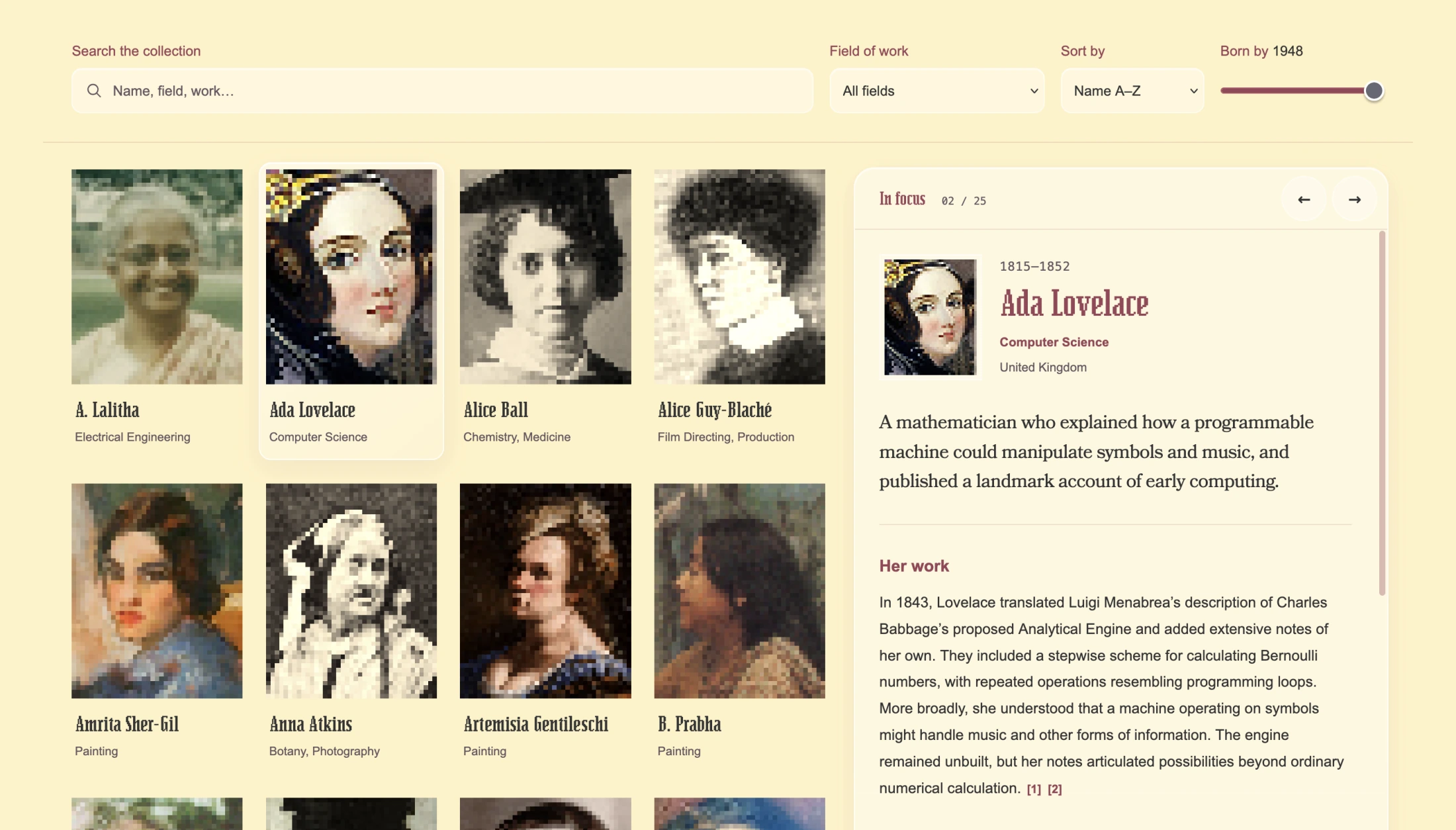
The Gallery of the Erased brings together 25 biographies across science, art and other fields. Search, field filters, sorting and a birth-year slider let readers find their own way in. Selecting a portrait opens a reading panel that separates her work, recognition and legacy, life events and references, while the collection stays in view.
The project
Whose story will you follow?
Compare the milestones, read the research and discover the people behind the patterns, with sources and historical context alongside.